Aeson
Metamorphoses (Ovid Edition)Aeson is the aged father whose body becomes the proving ground for Medea’s magic. His restoration is not merely a private cure: it publicly rewards filial loyalty, reunites him with the younger generation, and makes physical renewal the visible result of a chain of devotion, supplication, and enchantment.
Identity and Family Position
Aeson appears as the father of Jason and as a figure whose advanced age has reduced him to a condition of decrepitude. The evidence does not develop his earlier life in detail, but it places him within the royal and heroic world surrounding Jason’s return. His identity matters chiefly through kinship: the affection shown toward him creates the moral pressure that Medea answers, while his restored body becomes the sign that this family has recovered what age and misfortune had taken from it.
His place in a larger sacred genealogy is also emphasized through the claim that the speaker’s immediate lineage descends from Tantalus, the only mortal said to have been admitted to the gods’ feast. That reference situates Aeson’s surrounding narrative within a world where mortal families can be measured against divine privilege, and where extraordinary transformations expose both the reach and the limits of human claims to renewal.
Medea’s Intervention
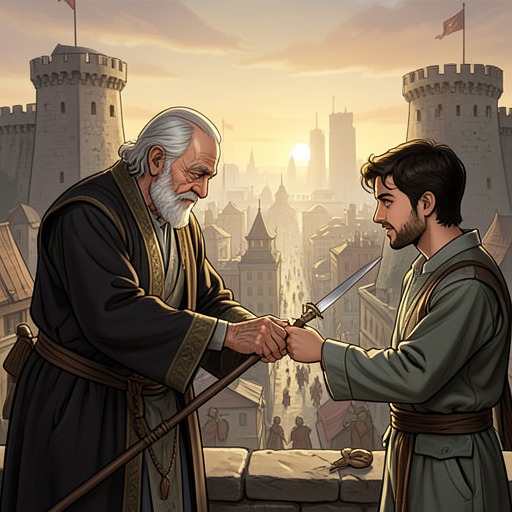
Medea first pursues the restoration through repeated prayers to an infernal power. Her persistence eventually prevails, after which she summons decrepit Aeson and renders him insensible with a sleeping draught. The procedure removes him from ordinary consciousness and places his body within a ritualized space between life and death; he lies on the earth like a corpse while Medea prepares the transformation.
The renewal is then enacted through violent surgery and magical replacement. Medea cuts the patient’s throat and replenishes the exhausted blood with a newly enchanted stream. The act joins medical imagery to supernatural metamorphosis: age is treated as a material condition that can be drained away and replaced, but only through an operation that outwardly resembles killing. Aeson’s revival therefore depends on a controlled passage through apparent death rather than on a gentle reversal of time.
The magic is presented as a deliberate process rather than an accidental marvel. Medea’s prayers secure the otherworldly assistance, the sleeping draught makes the old man passive, the cutting of the throat opens the body to change, and the enchanted flood supplies what age has depleted. Aeson’s transformation is consequently the product of an ordered sequence whose solemnity gives the spectacle the character of a rite.
Restoration and Its Consequences
The result is a return to youth. The account describes old Aeson as restored, and the consequences extend beyond his own body: Aemonian matrons who had mourned the absence of their sons rejoice when those prosperous sons return. Aeson’s rejuvenation is thus linked to a broader homecoming, joining the restoration of the father to the happiness of the households waiting for the heroes’ return.
His renewed youth also changes the emotional meaning of Jason’s success. The achievement is not complete when the expedition returns with its prize; it becomes complete when its benefits reach the older generation. Aeson embodies the past that the heroic quest must recover, and his restored body allows triumph to appear as continuity between generations rather than as glory possessed only by the adventurers.
Narrative Function and Significance
Aeson has little independent speech or action in the supplied episodes. His narrative function is instead concentrated in his vulnerability and in the response that vulnerability provokes. Medea’s power is made legible through what she can do for him, while filial piety supplies the justification that transforms dangerous magic into an apparent act of mercy.
The episode also establishes a sharp tension between renewal and violence. Aeson receives youth, but the route to youth passes through a body treated as dead and opened at the throat. The story therefore refuses to make immortality or restoration seem natural: the old order can be renewed only through an exceptional intervention that crosses ordinary human boundaries. Aeson’s transformation stands as both a promise of recovered life and a warning about the cost of forcing time to run backward.